
Many self-employed individuals and small-business owners weigh a SEP IRA against a Traditional IRA as you plan retirement, weighing contribution limits, tax timing, employer involvement, and flexibility; this concise guide helps you decide which aligns with your income profile and long-term goals.

Understanding SEP IRA
Key Features
If you run a business or are self-employed, a SEP IRA lets only employers make tax-deductible contributions on behalf of employees, with immediate vesting and flexible annual funding. Contributions are limited to a percentage of compensation-up to 25% or a maximum of $69,000 for 2024-and there are no employee salary-deferral or catch-up options; employer contributions must follow the plan formula and are deductible on the business tax return.
- Employer-funded only: you contribute from business earnings, not wage deferrals by employees.
- Contribution limit: up to 25% of an employee’s compensation or $69,000 in 2024, whichever is less.
- Immediate vesting: employees own all contributions as soon as they’re made.
- Uniform percentage: you must apply the same contribution percentage to all eligible employees.
- Self-employed calculation: for sole proprietors the effective rate is roughly 20% of net earnings after adjustments.
- Filing deadline: contributions can be made up to the employer’s tax-filing deadline, including extensions.
- Recognizing that contributions are discretionary year-to-year but, when made, must be proportional across eligible employees.
Eligibility Requirements
Employees generally become eligible if they are age 21 or older, have worked for you in at least three of the last five years, and meet the plan’s minimum compensation rule; once eligible, you must include them in the same percentage contributions you give yourself. Part-time or seasonal workers can be excluded if they don’t meet the service or compensation thresholds you specify in the plan document.
Your plan document defines exact rules within IRS parameters, so when you hire staff you should check service years and pay to determine inclusion. For example, if you make a 10% employer contribution for yourself, a 25-employee firm must contribute 10% for each eligible worker; for a sole proprietor with $100,000 net earnings, the self-employed contribution formula yields roughly a 20% practical contribution (about $20,000) after the required adjustments. Contributions must follow the plan terms and IRS limits each tax year.
Understanding Traditional IRA
Key Features
You get tax-deferred growth and potentially tax-deductible contributions, with an annual contribution limit of $6,500 (or $7,500 if you’re 50 or older). Withdrawals are taxed as ordinary income, and early distributions before 59½ generally incur a 10% penalty unless an exception applies. The deductibility of your contributions depends on your modified AGI and whether you or your spouse are covered by a workplace retirement plan.
- Contribution limits: $6,500 per year, $7,500 if age 50+ (catch-up).
- Tax treatment: Contributions may be tax-deductible; earnings grow tax-deferred until withdrawal.
- Withdrawals: Ordinary income tax applies; 10% penalty typically for distributions before age 59½.
- Required Minimum Distributions (RMDs): RMDs begin at age 73 under current rules, with future changes legislated for later years.
- Account access: Available through banks, brokerages, and custodians; you control investments from mutual funds to ETFs and bonds.
- Spousal and catch-up rules: Spousal IRAs allow contributions when one spouse has little or no earned income; catch-up allows extra contributions at 50+.
Eligibility Requirements
If you have earned income, you can contribute to a Traditional IRA regardless of age, and your spouse may use a spousal IRA if they have little or no income. Eligibility to deduct contributions on your tax return depends on your filing status, modified adjusted gross income (MAGI), and whether you or your spouse are covered by an employer retirement plan.
For example, if you’re under 50 and contribute the full $6,500, you reduce taxable income only if you meet the deduction rules; a self-employed person with no employer plan typically gets full deductibility, whereas someone covered by a workplace plan may face a phased deduction as MAGI rises. You should check your MAGI against current IRS phase-out ranges before claiming a deduction.
Contribution Limits Comparison
| SEP IRA | Traditional IRA |
|---|---|
| 2024 limit: employer contributions up to 25% of compensation or $69,000 (self-employed effective rate ≈20% of net earnings). | 2024 limit: you can contribute up to $7,000 ($8,000 if you’re 50 or older); contributions are made personally. |
| Who contributes: employer (including you as owner); contributions are tax-deductible to the business. | Who contributes: you; deductibility depends on income and workplace retirement coverage. |
| Catch-up: no separate catch-up provision; cap rises with compensation or IRS limit increases. | Catch-up: $1,000 additional if you’re 50+. |
| Example: if wages are $120,000, employer max = 25% → $30,000 (below the $69,000 cap); self-employed with $100,000 net ≈ $20,000. | Example: if you’re under 50 you can contribute $7,000 to a Traditional IRA; over 50 you can contribute $8,000 in 2024. |
SEP IRA Contribution Limits
With a SEP, your employer can contribute the lesser of 25% of your compensation or $69,000 in 2024; if you’re self-employed the practical math yields roughly 20% of net earnings after adjustments. For example, $150,000 in compensation could allow an employer contribution up to $37,500 (subject to the overall cap), letting you ramp up retirement funding far beyond standard IRA limits in a single year.
Traditional IRA Contribution Limits
With a Traditional IRA you may contribute up to $7,000 in 2024 ($8,000 if you’re 50 or older); contributions are made by you and may be tax-deductible depending on your modified adjusted gross income and whether you or your spouse are covered by a workplace plan. This structure suits steady annual saving even when employer plans aren’t available.
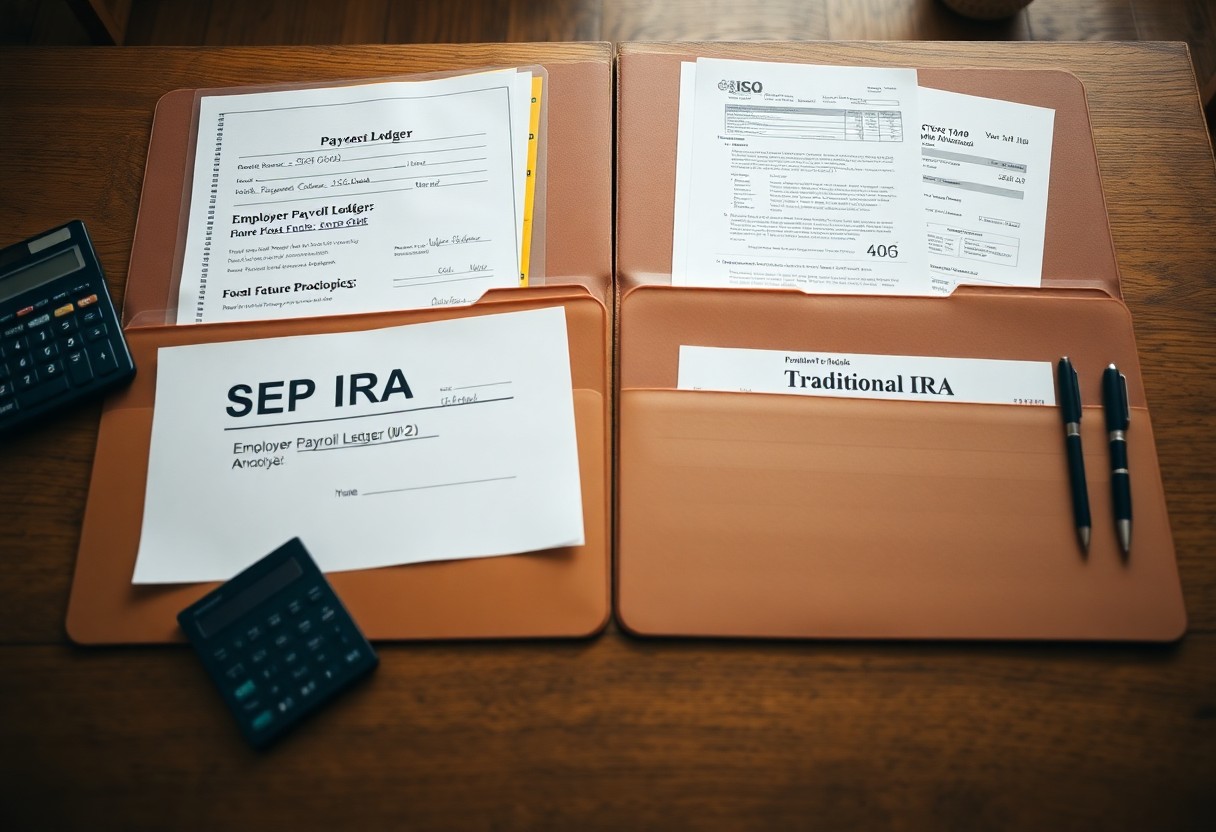
If your income limits your deduction, you can still contribute nondeductible Traditional IRA funds and consider strategies like a backdoor Roth conversion-contribute $7,000 nondeductible, then convert to Roth while accounting for the pro‑rata rule-to preserve tax-advantaged growth when direct Roth contributions are restricted.
Tax Implications
When evaluating tax effects, note that both plans defer taxes on gains, but contributions and withdrawals differ: SEP contributions are employer-deductible and reduce your business taxable income; Traditional IRA contributions may be deductible depending on your income and workplace retirement coverage. Distributions are taxed as ordinary income, early withdrawals before 59½ generally incur a 10% penalty, and required minimum distributions begin at age 73 under current rules, which can affect your retirement tax bracket.
Tax Benefits of SEP IRA
With a SEP, you-or your employer-can deduct contributions, lowering business taxable income; you can contribute up to 25% of compensation (capped-$66,000 in 2023), so a profitable small-business owner can shelter significant earnings. Contributions vest immediately and grow tax-deferred, enabling larger annual funding than most IRAs, but you must contribute proportionally for eligible employees, which influences payroll planning and cash flow.
Tax Benefits of Traditional IRA
You may be able to deduct Traditional IRA contributions, which reduces current taxable income; contribution limits were $6,500 in 2023 ($7,500 if 50+). Deductibility phases out with higher modified adjusted gross income-e.g., single filers covered by a workplace plan saw phase-outs around $73,000-$83,000 in 2023-so your eligibility depends on income and employer plan status.
For example, if you’re in the 24% bracket and contribute $6,500, you can lower current taxes by about $1,560. Alternatively, making nondeductible contributions allows tax-deferred growth and the possibility of a backdoor Roth conversion to bypass income limits; keep in mind conversions trigger tax on pre-tax amounts and RMDs will affect future taxable income, so model scenarios before choosing a path.
Withdrawal Rules
When you take distributions from a SEP or Traditional IRA, they’re taxed as ordinary income and follow the same federal rules: withdrawals before age 59½ typically incur a 10% penalty plus income tax, and required minimum distributions begin at age 73 for most people under current law. Because SEP contributions are employer-made and grow tax-deferred, your withdrawals are often fully taxable, whereas a Traditional IRA’s taxable portion depends on any nondeductible basis you’ve built.
Early Withdrawal Penalties
If you withdraw before 59½, the IRS generally applies a 10% penalty on the taxable portion in addition to income tax. Common exceptions include disability, death, substantially equal periodic payments (72(t)), qualified higher-education expenses, up to $10,000 for a first-time home purchase, and the $5,000 birth/adoption exception. For example, a $20,000 pre-59½ SEP distribution could cost roughly $2,000 in penalties before income tax unless an exception applies.
Required Minimum Distributions
RMDs apply to both SEP and Traditional IRAs and typically begin at age 73; you compute each year’s RMD by dividing your prior-year Dec. 31 account balance by the IRS life-expectancy factor. The excise tax for missed RMDs was reduced from 50% to 25% and can be trimmed further to 10% if corrected under IRS procedures after SECURE Act 2.0, so timely compliance materially reduces risk and cost.
You may aggregate RMDs from all your Traditional and SEP IRAs and take the total from one or more accounts, but you must calculate each account’s RMD separately. The first RMD is due by April 1 following the year you reach 73; subsequent RMDs are due by December 31 each year, so deferring the first distribution often forces you to take two large taxable distributions in one calendar year-plan withholding or timing accordingly.

Choosing the Right Option
When deciding which plan fits your situation, match contribution capacity to your business structure and long‑term tax outlook. If your business generates consistent profits and you want to shelter a large portion of income, a SEP lets you contribute a much higher share (up to 25% of compensation), whereas a Traditional IRA limits annual personal contributions to the low thousands but can offer deductible contributions depending on your income and workplace coverage. Factor in employee obligations and your expected retirement tax rate.
Factors to Consider
Compare contribution limits, who makes the contributions, employer obligations, and the presence of employees before choosing. Also assess income stability-high, predictable profits favor SEP; irregular earnings may favor IRA flexibility. Any decision should factor in how employer-matching requirements and proportional contributions will affect total payroll costs and employee benefits.
- Contribution capacity: SEP ≈ 25% of pay (can be tens of thousands); Traditional IRA limited to annual individual cap.
- Employer obligations: SEP requires pro rata contributions for eligible employees.
- Eligibility and deductibility: IRA deductibility phases out at higher MAGI if you have a workplace plan.
- Administrative ease: SEP has minimal paperwork; IRAs are simpler for individuals.
- Catch‑up contributions: IRAs allow age‑50+ catch‑ups; SEP does not provide special catch‑ups.
Situational Recommendations
If you run a one‑person business with room to save aggressively, you’ll likely benefit from a SEP in high‑income years – for example, a $150,000 net could support roughly a $37,500 employer contribution (25%). If you’re an employee, have modest savings capacity, or need catch‑up limits at 50+, the Traditional IRA often makes more sense for steady, individual contributions.
For mixed situations, alternate: you can use a SEP in profitable years and make Traditional IRA contributions in lean years to keep saving. If you employ others and can’t afford uniform contributions, you may prefer encouraging employee IRAs or exploring a solo 401(k) for more flexible employee features. Evaluate projected payroll, expected tax bracket changes, and how much you need to defer now versus later before committing.
Conclusion
Drawing together, you should weigh your employment status, income, and savings goals: choose a SEP IRA if you’re self-employed or run a small business and want higher employer-style contribution limits and simple administration; choose a Traditional IRA if you need greater individual flexibility, lower contribution limits but potential deductions now, or you’re aiming for nondiscriminatory personal savings. Consider future tax brackets, contribution capacity, and whether employer contributions matter to decide which suits your retirement plan.
safeirarollover.com | IRA Comparison Guide | Updated March 2026
SEP IRA vs Traditional IRA — Which One Should You Choose?
Two of the most powerful retirement accounts available — but they serve very different people. This guide breaks down the key differences between a SEP IRA and a Traditional IRA in plain English, so you can choose the right one for your situation in 2026.
Disclosure: This article contains referral links. If you open an account through our links, we may receive a commission at no cost to you. All recommendations are based on editorial merit only.
Quick Answer: If you are self-employed or own a small business, a SEP IRA lets you contribute significantly more than a Traditional IRA. If you are an employee or just starting out, a Traditional IRA is simpler and more accessible. Most people only qualify for one — read on to find out which one that is.
What’s in This Guide
- What is a SEP IRA?
- What is a Traditional IRA?
- SEP IRA vs Traditional IRA — key differences
- Contribution limits for 2026
- Who qualifies for each
- Tax benefits compared
- Which one should you choose?
- Can you have both?
- Best platforms to open either account
- Frequently asked questions
What Is a SEP IRA?
A SEP IRA — Simplified Employee Pension Individual Retirement Account — is a retirement account designed specifically for self-employed individuals, freelancers, and small business owners. The “simplified” in the name refers to the relatively straightforward setup compared to other business retirement plans like a Solo 401(k).
SEP IRAs are funded entirely by the employer — meaning if you are self-employed, you contribute as the employer, not as an employee. Employees cannot make their own contributions to a SEP IRA. This is one of the key structural differences from a Traditional IRA.
The biggest appeal of a SEP IRA is the dramatically higher contribution limit. In 2026, you can contribute up to 25% of your net self-employment income or $70,000 — whichever is lower. This makes it one of the most powerful retirement savings tools available to self-employed people.
What Is a Traditional IRA?
A Traditional IRA is an individual retirement account available to anyone with earned income, regardless of employment type. It is the most widely used IRA in the United States and forms the foundation of most people’s retirement savings strategy.
Contributions to a Traditional IRA may be tax-deductible depending on your income and whether you have access to a workplace retirement plan. Your money grows tax-deferred — meaning you pay no tax on investment gains until you withdraw the funds in retirement. Withdrawals in retirement are taxed as ordinary income.
The Traditional IRA is simpler, more flexible, and available to a much wider range of people than a SEP IRA. However, it comes with significantly lower contribution limits.
SEP IRA vs Traditional IRA — Key Differences at a Glance
Who can contribute:
- SEP IRA: Self-employed individuals and small business owners only
- Traditional IRA: Anyone with earned income
2026 contribution limit:
- SEP IRA: Up to $70,000 or 25% of net self-employment income
- Traditional IRA: $7,500 ($8,600 if age 50 or older)
Who funds the account:
- SEP IRA: Employer only (you, if self-employed)
- Traditional IRA: The individual account holder
Tax deduction:
- SEP IRA: Contributions are always tax-deductible
- Traditional IRA: Deductible depending on income and workplace plan access
Required Minimum Distributions:
- SEP IRA: Yes — begin at age 73
- Traditional IRA: Yes — begin at age 73
Early withdrawal penalty:
- SEP IRA: 10% if under age 59½ (with exceptions)
- Traditional IRA: 10% if under age 59½ (with exceptions)
Investment options:
- SEP IRA: Stocks, bonds, ETFs, mutual funds (same as Traditional)
- Traditional IRA: Stocks, bonds, ETFs, mutual funds
Roth conversion:
- SEP IRA: Yes — can convert to Roth IRA
- Traditional IRA: Yes — can convert to Roth IRA
2026 Contribution Limits in Detail
SEP IRA 2026 Limits
The SEP IRA contribution limit for 2026 is the lesser of 25% of net self-employment income or $70,000. This is up from $69,000 in 2025.
For a self-employed person earning $100,000 net, the maximum SEP IRA contribution would be $25,000 (25% of $100,000). For someone earning $200,000 net, the maximum would be $50,000. To hit the full $70,000 cap, you would need net self-employment income of $280,000 or more.
Note that net self-employment income is calculated after deducting the employer portion of self-employment tax — not your gross revenue.
Traditional IRA 2026 Limits
The Traditional IRA contribution limit for 2026 is $7,500 per year, or $8,600 if you are age 50 or older (the catch-up contribution). These limits apply per person — a married couple can each contribute up to $7,500 to their own separate IRAs.
You must have earned income at least equal to your contribution. If you earned $4,000 in 2026, the maximum you can contribute is $4,000 — not $7,500.
Who Qualifies for Each Account
SEP IRA — Who Qualifies
- Self-employed individuals with any amount of self-employment income
- Sole proprietors, freelancers, and independent contractors
- Small business owners — including those with employees (though you must contribute the same percentage for eligible employees as you do for yourself)
- Anyone with side income from freelancing or consulting, even if they also have a full-time job
Important: If you have employees, you must contribute the same percentage of their compensation to their SEP IRAs as you contribute to your own. This makes SEP IRAs less attractive for businesses with multiple employees.
Traditional IRA — Who Qualifies
- Anyone under age 73 with earned income
- Employees, self-employed individuals, and business owners
- Spouses with no income if filing jointly (spousal IRA rules apply)
There is no income limit for contributing to a Traditional IRA — however, the tax deductibility of your contribution phases out at higher incomes if you or your spouse have access to a workplace retirement plan.
Tax Benefits Compared
SEP IRA Tax Benefits
Contributions to a SEP IRA are always tax-deductible — there is no income limit that phases out the deduction. This is a significant advantage over the Traditional IRA. A self-employed person in the 32% tax bracket contributing $30,000 to a SEP IRA would save $9,600 in federal taxes in that year alone.
Funds grow tax-deferred inside the SEP IRA. Withdrawals in retirement are taxed as ordinary income, the same as a Traditional IRA.
Traditional IRA Tax Benefits
Traditional IRA contributions may or may not be tax-deductible depending on two factors — your income level and whether you or your spouse are covered by a workplace retirement plan.
If neither you nor your spouse has a workplace retirement plan, your contributions are fully deductible regardless of income. If you do have workplace plan access, deductibility begins phasing out at $81,000 for single filers and $129,000 for married filing jointly in 2026.
Even if your contributions are not deductible, a non-deductible Traditional IRA still provides tax-deferred growth — which has long-term value. However, many people in this situation are better served by a Roth IRA instead.
Which One Should You Choose?
Choose a SEP IRA if:
- You are self-employed, a freelancer, or run your own business
- You want to save significantly more than $7,500 per year for retirement
- You want a guaranteed tax deduction with no income phase-out
- You have no employees or only a few (factor in the employer contribution requirement)
- You want a simple setup without complex plan administration
Choose a Traditional IRA if:
- You are an employee with no self-employment income
- You are just starting to save for retirement and want a simple account
- Your income qualifies you for the tax deduction
- You want flexibility to contribute smaller amounts each month
- You plan to roll over a 401(k) from a previous employer
If you are self-employed with a full-time job:
You may qualify for both. You can contribute to a SEP IRA based on your self-employment income AND contribute to a Traditional IRA based on your earned income. Both contributions may be tax-deductible depending on your situation.
Can You Have Both a SEP IRA and a Traditional IRA?
Yes — you can have both accounts simultaneously. There is no rule preventing you from contributing to a SEP IRA and a Traditional IRA in the same year, as long as you have qualifying income for each.
However, having a SEP IRA counts as having a workplace retirement plan for Traditional IRA deductibility purposes. This means if your income exceeds the phase-out threshold ($81,000 for single filers in 2026), your Traditional IRA contributions may not be tax-deductible even if you are self-employed.
In that scenario, contributing to a Roth IRA (if your income qualifies) may be a better use of the $7,500 than a non-deductible Traditional IRA.
Best Platforms to Open a SEP IRA or Traditional IRA in 2026
All of the platforms below support both SEP IRAs and Traditional IRAs with no account minimums and commission-free trading.
Fidelity — Best overall. Unmatched rollover and IRA support, transfer status tracker, excellent educational resources for beginners. No fees, no minimums. Open a Fidelity account →
SoFi — Best for beginners who want all-in-one banking and investing. 1% IRA match on rollovers. Free financial planning included. Open a SoFi account →
Robinhood — Best for simple mobile-first investing. 1% match on IRA contributions. Commission-free, no minimums. Open a Robinhood account →
Webull — Best for self-directed investors who want advanced tools. Supports SEP IRA, Traditional IRA, and Roth IRA. Commission-free. Open a Webull account →
Ally — Best for combining banking and investing. Competitive rates, clean interface, no minimums. Open an Ally account →
Frequently Asked Questions
Can I contribute to a SEP IRA and a 401(k) in the same year?
Yes — if you have both self-employment income and an employer 401(k), you can contribute to both in the same year. The limits are calculated separately. This is one of the most powerful retirement savings strategies for people with side income.
Does a SEP IRA have a Roth option?
No — SEP IRAs are always pre-tax accounts. However you can convert SEP IRA funds to a Roth IRA, which is a taxable event in the year of conversion. There is no Roth SEP IRA option.
What happens to my SEP IRA if I close my business?
The SEP IRA remains yours regardless of your business status. You can stop contributing, roll it over to a Traditional IRA or another employer plan, or leave it invested where it is. Closing your business does not affect your existing SEP IRA balance.
Can I make a late SEP IRA contribution for last year?
Yes — SEP IRA contributions for a given tax year can be made up to the tax filing deadline including extensions. For 2025 taxes, you can make a SEP IRA contribution as late as October 2026 if you file an extension. This is a significant advantage over Traditional and Roth IRAs which have a hard April deadline.
What is the difference between a SEP IRA and a Solo 401(k)?
Both are designed for self-employed people but a Solo 401(k) allows both employee and employer contributions, has a higher total contribution limit, and allows Roth contributions. A SEP IRA is simpler to set up. For most self-employed people earning under $100,000, the difference is small. Above that income level, a Solo 401(k) often allows larger total contributions.
Final Thoughts
The SEP IRA and Traditional IRA are both excellent retirement accounts — they just serve different people. If you have self-employment income, the SEP IRA’s higher contribution limit and guaranteed deductibility make it one of the best retirement savings tools available. If you are an employee without self-employment income, the Traditional IRA is your most accessible option.
The best move is often to use both if you qualify — maximize your SEP IRA first (larger tax deduction), then consider a Traditional or Roth IRA with remaining savings capacity.
Reminder: This guide is for educational purposes only and does not constitute financial or tax advice. Consult a qualified professional for advice specific to your situation.
safeirarollover.com | Independent, unsponsored financial guidance for beginners | Updated March 2026